too Black, but also too White
This post has been brought over from my Medium page, where it existed first. From April 2026 onward, all of my writing will be published here first and syndicated elsewhere.
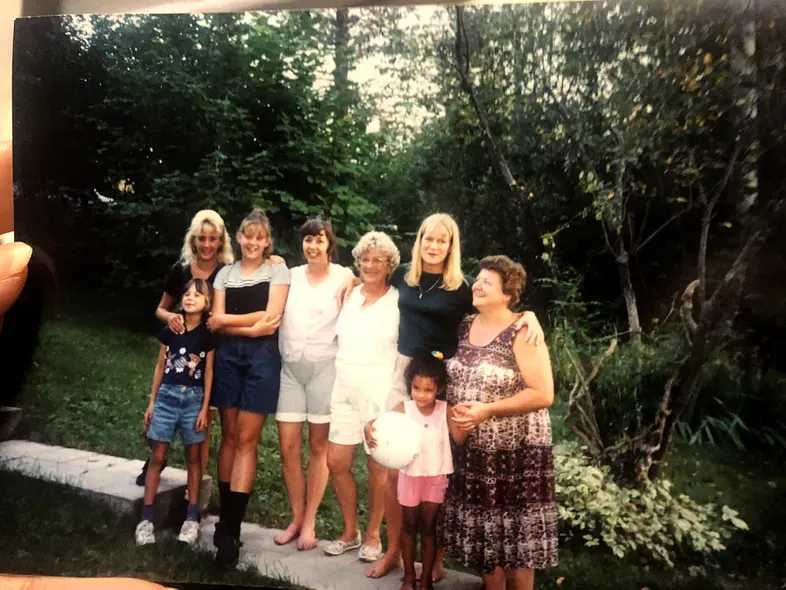
The first time I remember feeling different from everyone else was when a boy in 2nd grade called me ugly because my hair was “too big.” To be fair, my hair was huge. It was a gorgeous, poofy, red-brown mess of curls that my mother had no idea what to do with, so I wore it down most of the time.
Adults would swoon over my locks, touching them without permission until my mom learned to intervene. The kids, though. They were harsh. They saw a girl who looked different and teased, maybe out of curiosity or jealousy.
I remember my relationship with my hair changing around that age, and the effort I began to put forth to tame my frizz, fighting to fit in by fighting against my natural self.
The literal black sheep
My childhood is sprinkled with similar memories of me feeling out of place, almost alien. Like when I flew down to Oregon to visit my maternal grandmother one year and her neighbor, after seeing me play in the front yard, phoned my grandmother to let her know that she had seen a “negra” loitering on her property.
Or when my elementary music teacher singled me out in class to tell me that I naturally sing different from my peers because of my wide mouth. Or when I was told I had DSL in 6th grade — which might actually be a universal experience for young girls because middle school boys are awful.
There are also stories of my childhood, colored by race, that I don’t remember, but were later told to me. Like when I was at the mall with my very Caucasian, blue-eyed, blonde-haired mother, asking her (quite loudly) what the N-word meant, because it was in a TLC song we would listen to. Or family members asking ignorant questions like “What will you do when she gets ashy?” — yes, that really happened.
I could recite a dozen more borderline-traumatic experiences as a biracial girl growing up in a white town, within a white family, being taught at white schools, but I think you get the point.
The funniest part is, I didn’t know I was any different from anyone else until remarks were made about my skin or my hair or my facial features. Race was not talked about in my house, not even constructively.
Nothing about me looking the way I looked and my mother looking the way she looked seemed odd to me until I began noticing the reactions and opinions of those around us. It was then that I began to understand that people placed me in a category according to what I looked like. That my identity = my phenotype.
Family dynamics and belonging
The complexity of identity becomes even more pronounced within family dynamics. For me, growing up with a white mother meant experiencing love alongside significant gaps in understanding. These gaps created a wedge between us that grew as I did.
As a child, my stepfather — who had co-parented me for six years — openly called me the N-word to my mother’s face, but behind my back. I only learned about this incident recently, but it explains so much about the tension I always felt at home.
Not having my father in my life growing up is a major part of my story and struggle with identity. But not having anyone in my family, or school, or the surrounding community helped form my self concept — and was devastating to my self esteem.
The geography of identity
I know my experience with identity was largely shaped by my mother raising me on her own, but it had just as much to do with where I was raised geographically.
My earliest years were spent growing up in the rural little towns of Colville and Elk. Combined population ~ 10,000 souls.
At eleven, I flew to Miami and spent a year living with my paternal grandmother. Down there, everything flipped. Suddenly, I was “the White girl” in school instead of “the Black girl.” Again, my identity was determined by what I looked like only.
I was teased for my lack of melanin and the “proper” way I spoke. At the same time, I found myself put on a pedestal by some boys who clearly had budding colorist views, even if they weren’t aware of it yet.
The Venezuelan girls were the only ones who really spoke to me, even if it was in Spanish. It was a major culture shock, but I’m grateful for that early lesson in perspective.
That year in Miami shattered any illusion I had about easily finding a place to belong. I realized that I really didn’t fit in neatly anywhere — too Black for the White kids, too White for the Black kids. I returned home with a new understanding of race and culture, but my sense of belonging felt even more fractured.
When I returned to Washington, my mother was living in a new city. A suburban place called Spokane. It was different from anything I had ever experienced. I lived there for six years and it taught me a lot about myself and relationships.
While I wouldn’t call it a diverse area, with a Black population of under 3%, I did meet kids just like me. Not just mixed, but mixed with a White mother and Black father. The difference that made in a little girl who struggled to feel like she fit anywhere cannot be overstated. Still, there were many challenges I and others faced with racism and prejudice.
Finding a home in the south
I moved from Spokane at 18 and bounced around for a few years. When I was twenty-four, I moved from Massachusetts to my then-husband’s hometown in Georgia, and everything changed. I remember seeing a Black person on a billboard for the first time in my life. I could not believe my eyes.
Metro Atlanta has offered community and inclusion to me in a way no where else has. Here, I have witnessed what is possible when people of color stick together and mobilized. There is also opportunity here like nowhere else.
But, it’s not perfect, and binary racial views are prevalent here as well.
When my marriage dissolved, I chose to stay anyway. It was important to me to raise my children in a place where they wouldn’t have to experience the lack of representation I did.
My mother still lives across the country and doesn’t understand this choice, and that’s okay. No one can be expected to understand what it feels like to finally see yourself in others when you grew up without that if they never experienced it themselves.
On racial ambiguity and the opinions of others
As a teenager, I was always answering the question “What are you?” — as if I was an exotic artifact requiring classification. Here, I get asked what I’m mixed with. Despite the fact that genes can show up in many ways, my light skin and larger curls are apparently a dead giveaway that I am not “full Black.”
Interestingly enough, my children also field this question often. Despite them having 75% African ancestry, their schoolmates consider them to be mixed kids.
Being instantly categorized as one thing or the other has made me hyper aware of the biases and prejudices of different groups of people. It’s also given me a unique perspective on race, culture, identity, and ethnicity. To me, identity is what you make it. It cannot be given to you. It cannot be accepted or validated. It is also extremely complex and never one thing.
Redefining identity on your own terms
Years of existing between polarized racial categories taught me that mixed-race identity is actually its own complete experience. I learned that in order to reclaim my identity, I had to reframe it and stop defining it by racial group. I don’t define myself as a black woman, a white woman, a mixed woman. I am just me. I know that’ll ruffle some feathers, but so be it.
Identity is something we actively construct, shape, and reshape throughout our lives. My journey from that confused 2nd grader with the “too big” hair to a woman who honors her complexity has taught me that.
I want the children growing up today — including my own — to inherit a world with more space for expressing the full spectrum of human identity, without socially constructed categories. Because identity is not one thing; it is complex, and it is whatever you say it is.